
The best way to memorize anything, a new language included, isn’t reading it again. It’s guessing first, thinking hard, and pulling the answer out of your own memory. It feels slower and harder. That’s exactly why it works, and over a century of memory research backs it up.
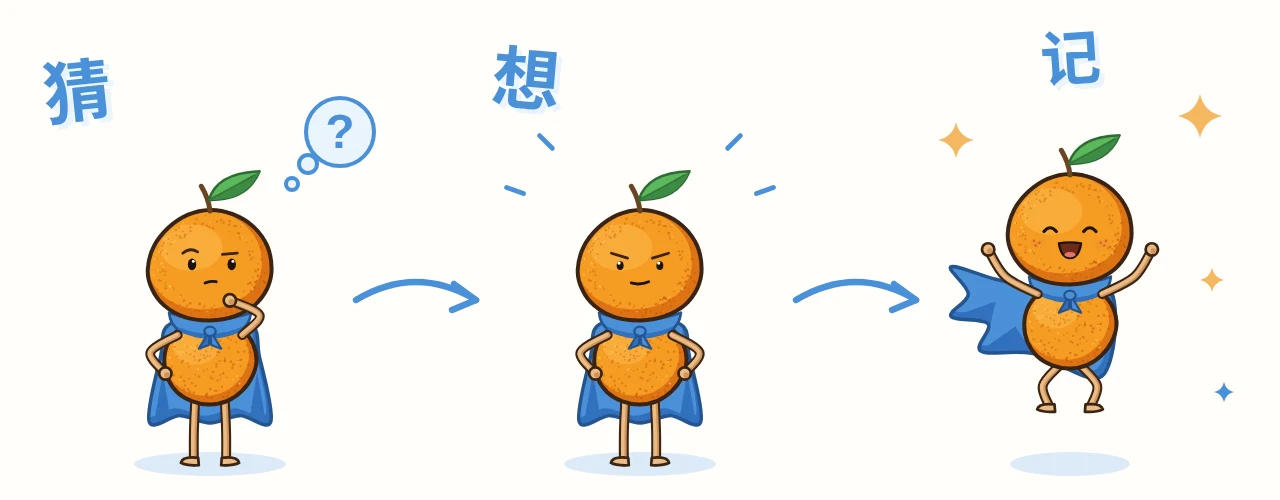
Here’s the method in three steps, and the studies behind each one.
| Step | What you do | What the research calls it |
|---|---|---|
| 1. Guess | Have a go before you see the answer | Pretesting, errorful generation |
| 2. Think hard | Stay with it for a moment, even when it’s uncomfortable | Desirable difficulties, retrieval effort |
| 3. Remember | Pull the answer from memory, again and again, days apart | Retrieval practice, spacing |
Why rereading lets you down
Most people study by reading things again, highlighting, or copying lists. It feels great: the words look familiar, so it feels like you know them.
In 2013, a team of psychologists led by John Dunlosky reviewed hundreds of studies on ten popular study techniques. Rereading and highlighting came out as “low utility”. Only two techniques got the top rating: practice testing and spreading practice out over time (Dunlosky et al., 2013).
The clearest demonstration comes from Roediger and Karpicke (2006). Students learned a text and then either read it again or tried to recall it from memory, without even seeing the answers.
| Final test after… | Read it again | Recalled it from memory |
|---|---|---|
| 5 minutes | 81% | 75% |
| 2 days | 54% | 68% |
| 1 week | 42% | 56% |
Rereading wins for five minutes. After that, recalling wins every time. In their second experiment, students who reread the text four times were the most confident they’d remember it, and remembered the least a week later: 40%, against 61% for students who mostly tested themselves.
That’s the trap. The method that feels best is the one that fades fastest.
Step 1: Guess before you know
Trying to answer before you’ve learned the answer sounds pointless. You’ll probably be wrong. But being wrong, and then seeing the right answer straight away, makes that answer stick better.
- Kornell, Hays and Bjork (2009) found that people who tried and failed to answer a question, and then saw the answer, learned more than people who were simply shown the question and answer together.
- Potts and Shanks (2014) found the same for foreign words: learners who guessed the meaning of Basque words before seeing the translation did better on a later test than learners who just read the pairs.
- Butterfield and Metcalfe (2001) found that the mistakes you’re most sure about are the ones you correct best. The surprise grabs your attention.
A guess turns you from a reader into a player. Your brain has made a bet, so it pays attention to the result.
To be fair: a wild guess at a random foreign word, with nothing to go on, doesn’t help much and can even get in the way (Butowska et al., 2022). Guessing works when you have a clue to reason from and see the answer right away. Chinese is full of clues. Take this line from Mandarin Hero’s Restaurant lesson:
服务员,买单! Fúwùyuán, mǎidān! — Excuse me, the bill please!
You might know 买 (mǎi), “to buy”. 单 (dān) is a list or a slip of paper. “Buy the slip” at the end of a meal? You can guess 买单 means paying the bill, and once you’ve guessed it, you won’t forget it.
Step 2: Think hard (the struggle is the point)
When a word is on the tip of your tongue, the urge is to flip the card right away. Don’t. Those few seconds of effort are where the learning happens.
Psychologist Robert Bjork calls these desirable difficulties: things that make learning feel slower and harder in the moment, but make it last much longer (Bjork, 1994). The struggle tells your brain: this matters, keep it.
Pyc and Rawson (2009) put this to the test with word translations: the harder a correct recall was to reach, the better it was remembered later. An easy recall, right after you’ve seen something, does little. A recall you had to dig for does a lot.
So give each card a real go. Say the answer out loud, tones and all, before you check.
Step 3: Remember, again and again
Every time you pull a word out of memory, the path to it gets stronger. Not seeing it again: recalling it.
Karpicke and Roediger (2008) had students learn 40 Swahili words. Some kept testing themselves on every word, even ones they’d already got right. Others stopped testing a word once they knew it, and only kept rereading it. A week later, the first group remembered about 80%. The second group: about 35%. Same words, same study time. The only difference was recalling instead of rereading.
Recall also beats techniques that feel deeper. In Karpicke and Blunt (2011), students who practised recalling a text outscored students who built detailed concept maps of it, on a test a week later.
And it works best spread out. A large review of spacing studies found that reviews with gaps between them beat cramming, and that the longer you want to remember, the longer the gaps should be (Cepeda et al., 2006). That’s what spaced repetition does: each word comes back just before you’d forget it, when recalling it still takes some effort.
Why this is perfect for a new language
A language is thousands of small things you need on demand: in the middle of a conversation, with no time to look anything up. Recognizing a word on a page isn’t enough. You need to pull it out yourself, fast.
That’s exactly the skill this method trains. Rereading trains recognizing. Guessing, struggling and recalling train producing, which is what speaking actually is.
How to use it today
- Cover the answer. Look at the Chinese (or the English) and come up with the other side before you check.
- Have a go, even if you’re unsure. Use what you have: a part of the character, the sound, the situation.
- Give it a few seconds. Don’t flip at the first flicker of doubt.
- Check right away, and say the correct answer out loud.
- Be honest. Didn’t know it? Mark it as forgotten so it comes back soon.
- Bring it back later: tomorrow, in a few days, next week.
How Mandarin Hero builds it in
Mandarin Hero is built around these three steps. Every card asks you to think of the answer first, then check, and then say honestly whether you knew it: Forgot, Hard, Recalled or Easy. Lessons introduce new words and phrases from real situations, like the 买单 above. After that, Practice brings each one back on a spaced schedule, sooner if you forgot it. A word only counts as mastered once every card for it has reached a 21-day interval, so you’ve proven you can recall it weeks apart, not just minutes.

It’s harder than scrolling through a word list. That’s the point. Comparing apps? Here’s an honest look at the best apps for spoken Mandarin.
Sources
- Bjork, R. A. (1994). Memory and metamemory considerations in the training of human beings. In Metacognition: Knowing about Knowing, MIT Press.
- Butowska, E., Hanczakowski, M., & Zawadzka, K. (2022). You won’t guess that: On the limited benefits of guessing when learning a foreign language. Memory & Cognition.
- Butterfield, B., & Metcalfe, J. (2001). Errors committed with high confidence are hypercorrected. Journal of Experimental Psychology: Learning, Memory, and Cognition.
- Cepeda, N. J., et al. (2006). Distributed practice in verbal recall tasks. Psychological Bulletin.
- Dunlosky, J., et al. (2013). Improving students’ learning with effective learning techniques. Psychological Science in the Public Interest.
- Karpicke, J. D., & Blunt, J. R. (2011). Retrieval practice produces more learning than elaborative studying with concept mapping. Science.
- Karpicke, J. D., & Roediger, H. L. (2008). The critical importance of retrieval for learning. Science.
- Kornell, N., Hays, M. J., & Bjork, R. A. (2009). Unsuccessful retrieval attempts enhance subsequent learning. Journal of Experimental Psychology: Learning, Memory, and Cognition.
- Potts, R., & Shanks, D. R. (2014). The benefit of generating errors during learning. Journal of Experimental Psychology: General.
- Pyc, M. A., & Rawson, K. A. (2009). Testing the retrieval effort hypothesis. Journal of Memory and Language.
- Roediger, H. L., & Karpicke, J. D. (2006). Test-enhanced learning: Taking memory tests improves long-term retention. Psychological Science.